
Contents
- 1 Laser eyeliner tattoo removal
- 1.1 Is it possible to remove eyeliner tattoos?
- 1.2 Instructions on how to remove permanent eyeliner
- 1.3 Can permanent eyeliner be removed at home?
- 1.4 Remove eyeliner tattoos with laser technology
- 1.5 What is the healing process like for permanent eyeliner removal?
- 1.6 Aftercare for eyeliner tattoo removal
- 1.7 What are the potential risks associated with eyeliner tattoo removal?
- 1.8 Main Takeaways
- 1.9 FAQ
- 1.9.1 What are the available methods for removing permanent eyeliner tattoos?
- 1.9.2 Can permanent eyeliner be removed at home?
- 1.9.3 How does laser tattoo removal work, and is it effective?
- 1.9.4 What is the healing process like for permanent eyeliner removal?
- 1.9.5 What are the potential risks associated with eyeliner tattoo removal?
Laser eyeliner tattoo removal
Cosmetic tattooing, also known as micropigmentation, permanent makeup, and permanent eyeliner, aims to enhance facial features for a natural and long-lasting look. However, individuals often report common issues such as harsh colours, mismatched results, incorrect or irregular shapes, smudged lines, or colour migration. Assistance is required to address these concerns.
Is it possible to remove eyeliner tattoos?
Permanent eyeliner removal is possible.
However, it does require time, patience, and a significant amount of money.
The removal process for tattoo pigment particles involves a series of treatments that gradually lighten the pigments until they are no longer visible.
There are options available for tattoo removal, including complete removal or correction of any pigmentation movement or unwanted designs.
Instructions on how to remove permanent eyeliner
There are three commonly used methods for eyeliner tattoo removal.
- Laser removal
- Saline removal
- Glycolic Acid Removal
The treatments are performed by certified professionals in removal techniques.
These methods involve penetrating the skin in various ways and require multiple sessions, typically 2-10 sessions spaced 6-8 weeks apart, to remove eyeliner tattoos successfully.
Can permanent eyeliner be removed at home?
There is currently no effective method for removing eyeliner tattoos at home.
To help fade your eyeliner, exercise regularly or use skincare products, such as Retinol, with ingredients that fade permanent makeup pigments. Also, prolonged exposure to sunlight and contact with salt or pool water may accelerate pigment fading.
These methods may cause the eyeliner tattoo to fade, but they will not altogether remove it.


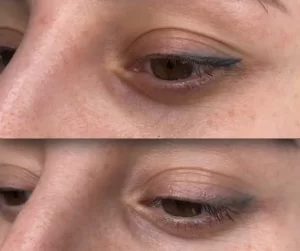
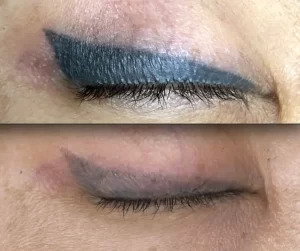
Remove eyeliner tattoos with laser technology
The laser method is commonly used for tattoo removal and removing permanent makeup.
How Does It Work?
Is It Efficient?
Removing laser eyeliner tattoos is effective, particularly with black and deep brown pigments typically used in eyeliner PMU. However, the process demands time and patience.
The total number of treatments required for complete removal varies based on several factors, including the concentration of pigments in the skin, the composition of the pigment, and how deeply it was injected. Completion of the process may necessitate up to 8 sessions or possibly more.
Is It Safe?
In general, yes, if the removal technician is knowledgeable and skilled.
Not all laser devices are suitable for use on the sensitive skin of the eyelids, and specific lasers may not be safe for use on darker skin due to the risk of hypo- and hyper-pigmentation caused by using the wrong wavelength.
Ocular shields are inserted into the eyes to receive treatment. Like metal contact lenses, these shields safeguard the cornea from laser beams. They may cause some discomfort, especially for individuals not accustomed to wearing lenses, but they effectively protect the eyes.
Does It Hurt?
Laser eyeliner tattoo removal can be uncomfortable.
A local anesthetic is used to reduce pain during the procedure, but due to the delicate nature of the eyelid area, you may experience some discomfort.
Fortunately, a session typically lasts for about 15 minutes.
What is the cost?
Laser eyeliner tattoo removal costs around $250 per session on average. It is expected to require up to 8 sessions to accumulate the total expenses.
Eyeliner tattoo removal is typically more costly than laser eyebrow tattoo removal due to the specialised skills and equipment required.
Is there any additional information that I should be aware of?
Two things.
Laser eyeliner tattoo removal can only be performed on tattoos at least six months old, as the high concentration of pigment in fresher tattoos can result in skin damage from the laser beam.
Also, laser removal is ineffective for reddish or yellow pigments. Eyeliner tattoos typically consist of black ink, but if you have a warm brownish eyeliner tattoo, it may be necessary to utilise a combination of removal methods.
Remove the partial eyeliner tattoo
If your permanent eyeliner has bled out in certain areas, removing the entire thing may not be necessary.
The skin of the eyelids has unique properties, and permanent eyeliner may experience pigment migration, particularly in the outer corners, resulting in a messy appearance.
If that is the situation, partial eyeliner tattoo removal is an option to fix the specific area. Any techniques described above will be effective, and you may require fewer sessions than complete removal.
What is the healing process like for permanent eyeliner removal?
Following each removal session, the skin undergoes a healing process that resembles the healing process after receiving an eyeliner tattoo.
After the procedure, the affected area may experience swelling and redness for two days. Scabs then form and eventually fall off, leading to a peeling phase. It is essential to refrain from touching the scabs.
The healing process typically takes longer than 14 days, as internal tissues require additional recovery. It is necessary to wait 6-8 weeks after each removal session before undergoing another one.
Aftercare for eyeliner tattoo removal
Regardless of the method of removal, specific aftercare instructions apply to all.
After each permanent eyeliner removal session, it is recommended to follow these tips to minimise complications and achieve optimal results.
- Maintaining cleanliness and dryness in the treated area for three days is essential. Follow the instructions provided by your removal technician for proper cleaning.
- Starting on day 3, applying a moisturiser that the technician has recommended is advised. This will aid in quicker wound healing and reduce itching.
- To prevent scarring, it is advisable not to pick at scabs.
- Refraining from activities that may cause heat, hot water, heavy sweating, swimming, or sun exposure is advised.
- Stay hydrated.
- Avoid high-pressure water.
- Avoid alcohol and smoking.
What are the potential risks associated with eyeliner tattoo removal?
What are the potential risks associated with eyeliner tattoo removal?
When conducted by a skilled and certified removal expert, these techniques are deemed safe. Nonetheless, it’s essential to acknowledge that they require breaking the skin’s barrier, which may introduce specific hazards.
- Scarring stands as the primary concern in the removal of permanent eyeliner. In cases where the removal specialist is not meticulous, excessive trauma to the skin can lead to enduring scars. This danger is more pronounced in saline and glycolic acid methods, as they necessitate incising the skin with a tool. Similarly, using an incorrect laser wavelength can also lead to scarring.
- Infections are possible if the requisite hygienic and safety protocols are not rigorously followed during the procedure. Although most infections are minor, there are instances of more severe complications. Preventing such outcomes is crucial, particularly by steering clear of uncertified or self-trained practitioners.
- The substances utilised in saline and glycolic acid removal methods could trigger allergic reactions. Therefore, conducting a patch test before the procedure is advisable to confirm no allergies to the used products.
Main Takeaways
Three proficient methods exist for permanently eradicating eyeliner: laser, saline, and glycolic acid removal techniques.
Deciding on the removal method is influenced by the state of your tattoo. Thus, booking a consultation with a removal expert is advisable to identify the most appropriate method.
FAQ
What are the available methods for removing permanent eyeliner tattoos?
Can permanent eyeliner be removed at home?
How does laser tattoo removal work, and is it effective?
What is the healing process like for permanent eyeliner removal?
What are the potential risks associated with eyeliner tattoo removal?
Potential risks include scarring, particularly if the removal is not done correctly, and infections due to breaking the skin’s barrier. Allergic reactions are also possible, especially with saline and glycolic acid removal methods.